Lula Sends Speculators a Clear Message: Brazil Is Doing Fine, Thank You
Pressed for fiscal adjustment, the president said he took over a government in the red, that he is delivering the Budget with a surplus and that the poor will not foot the bill. The data confirm the eight years of surpluses and show that 95% of the nominal shortfall is interest; the inherited “2.8% deficit” does not appear in the statistics.
Adapted translation of the Portuguese original. Read the original.
 Cartoon
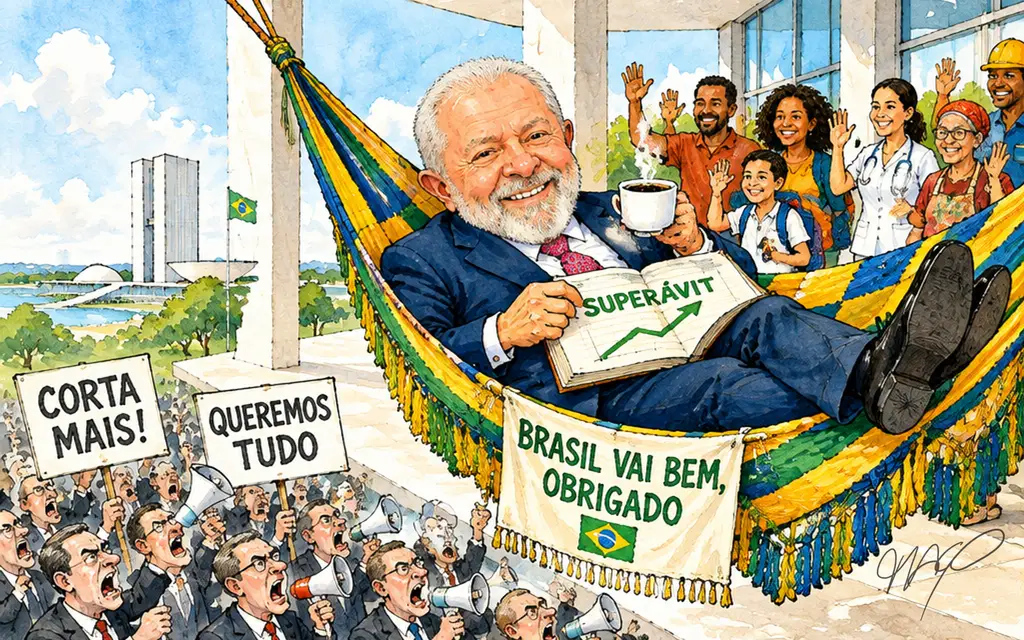
On Friday (November 6), after an extraordinary meeting of the National Energy Policy Council (CNPE) in Brasília, Luiz Inácio Lula da Silva (PT) was pressed once again for a fiscal adjustment that financial speculators consider too small. The answer came in the form of a message, and the message was the usual one: Brazil is doing fine, thank you.
“Can anyone say that this government has no fiscal responsibility?”
Abestadão sorted out the president's statements and went looking for the official numbers behind each one. Some claims the data confirm with room to spare, others they correct, and there is one calculation that almost nobody does out loud.
“How many countries have the fiscal seriousness that we have?”
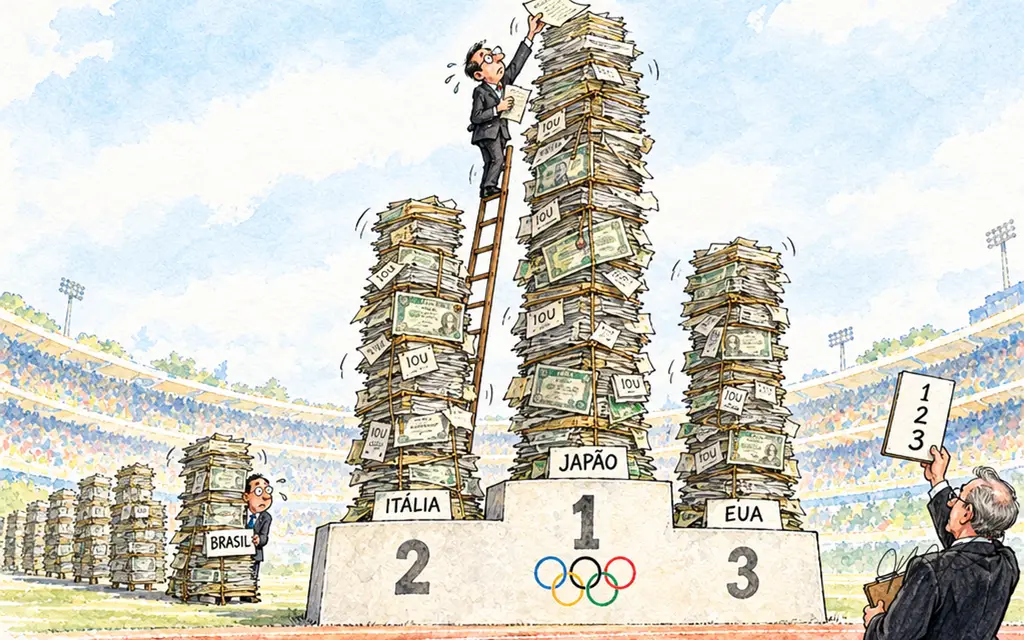
“How many countries have the fiscal seriousness that we have? What is the domestic debt of the United States? Of France? Of Japan? Of Italy? Next to ours, it is double in relation to GDP.”
According to the International Monetary Fund, which measures every country the same way, Brazil's gross debt closed 2025 at 93.3% of GDP. Japan's stood at 204.8%, Italy's at 137.1%, the United States' at 124.4% and France's at 115.5%. Brazil owes less, proportionally, than any of the four he cited. “Double,” however, holds only for Japan: American debt is a third larger than Brazil's, and French debt a quarter larger. The full G20 list is in this Abestadão report.
“It's not even everything that shows up”
“If we analyze our debt for real, it is not even everything that shows up.”
“What is presented as Brazilian public debt is not.”
Here the complaint has a technical basis. The Central Bank's gross debt, at R$11.1 trillion (82.9% of GDP) in September, includes R$1.37 trillion in repo operations (“operações compromissadas”), which the Central Bank itself uses to drain money from the economy and control interest rates, not to pay government expenses. Under the IMF's concept, which also counts the bonds held in the Central Bank's own portfolio, the same debt becomes 94.5% of GDP. And net debt, which subtracts what the country is owed, including US$362.6 billion in international reserves, stands at 70% of GDP.
The problem does not disappear with the math: gross debt rose from 71.4% of GDP in January 2023 to 82.9% now. What the president is saying is that the number that frightens the news is the biggest of them all, and that is true.
“We took over this government with a 2.8% deficit”
“And you in the press who are here, I'll tell you: we took over this government with a 2.8% deficit.”
This is the statement the data do not confirm. In 2022, Bolsonaro's last year, the central government closed with a surplus of R$54.1 billion (0.5% of GDP), and the public sector as a whole with a surplus of 1.25%, according to the Central Bank. The 2.8% figure does not appear in any official statistic for that year.
What the government inherited was something else: a queue of “precatórios,” the Union's court-ordered debts, pushed forward by the constitutional amendment passed in 2021. In 2023, the government paid R$92.4 billion of those arrears at once, and the year closed with a deficit of R$230.5 billion (2.1% of GDP). Without the precatórios, the shortfall would be 1.3%. The bill belonged to the previous government; the inherited 2.8% deficit did not.
“We are now delivering the Budget with a surplus”
“And we are now delivering the Budget with a surplus.”
The 2027 Budget bill does, in fact, project a surplus: R$18.6 billion, or 0.1% of GDP, with no accounting trick. With the precatório deductions allowed by law, the result reaches R$83.4 billion (0.6%), above the 0.5% target. The Senate's Independent Fiscal Institution (IFI) doubts it and projects a deficit of R$86.1 billion, which would force new spending freezes.
The road to here has been one of small deficits: 0.40% of GDP in 2024 and 0.43% in 2025 in the public sector, with the 2025 target met thanks to expenses that the law says to count outside it.
“The only president who ran a surplus every year”
“I have my record with me. I was the only president, from 2003 to 2010, who ran a primary surplus every year.”
The eight years check out. The public sector ran a primary surplus in every one of them, from 3.74% of GDP in 2005 to 1.94% in 2009, the year of the global crisis. The “only” is debatable: Fernando Henrique Cardoso also left office with a surplus (3.19% of GDP in 2002). Dilma, Temer and Bolsonaro each ran a deficit in at least two years; so has Lula in his third term.
“It wants everything”

“It's not what the financial system wants, because it wants everything. No. It's what we can do.”
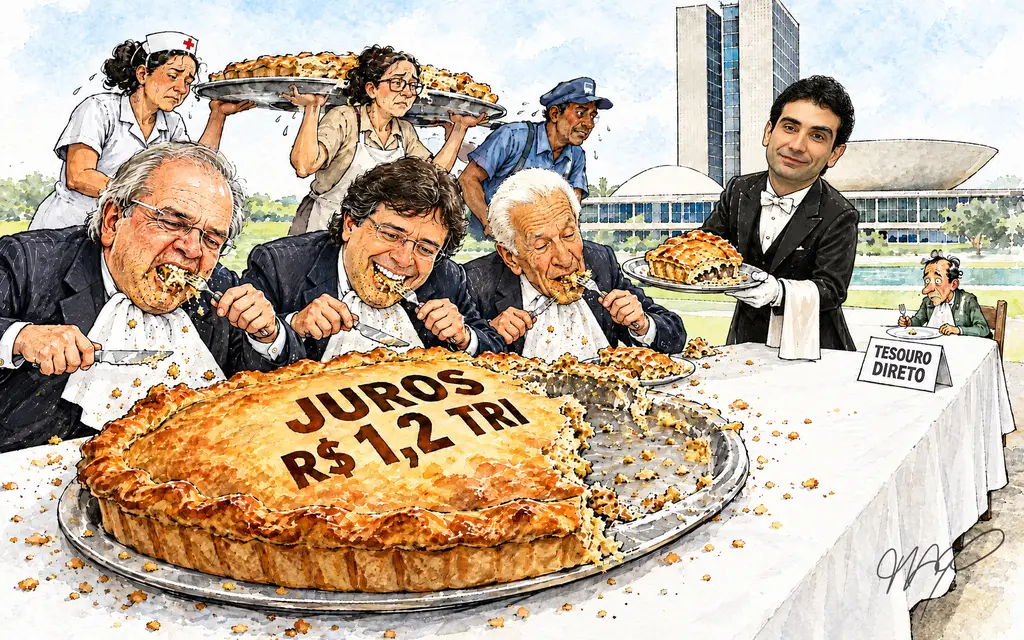
The numbers back the president on the part that stings most. In the 12 months through September, the public sector paid R$1.205 trillion in interest, 8.99% of GDP. The primary deficit, the one that measures spending against revenue and drives every demand for cuts, was 0.52%. Together they make the nominal deficit of 9.51% of GDP: 95% of it is interest. With the Selic (Brazil's benchmark interest rate) at 13.75%, whoever profits from the debt is whoever holds it, and Abestadão has already shown who gets that money.

“The poor will not foot the bill”
“The poor will not foot the bill. We will not put the poor people through any sacrifice.”
“This country will continue with social responsibility.”
Unemployment stood at 5.2% in the quarter through September, the lowest for that period since IBGE, the national statistics agency, began the series in 2012. The economy grew 2.3% in 2025. Inflation is the weak point of the message: 4.58% over 12 months through September, above the 4.5% ceiling of the target.
The message, then, arrives with a correction and a calculation. The correction: Lula did not inherit a 2.8% deficit; he inherited a surplus and a pile of precatórios. The calculation: of the nominal shortfall, about five cents of every real come from the gap between spending and revenue; the other 95 go to interest. That is the part about which the speculators usually prefer silence.
Sources
- Lula diz que dívida pública 'nem é tudo o que aparece' e repete que o pobre não pagará a conta
Lula's remarks to reporters after the CNPE extraordinary meeting: fiscal seriousness, US and French debt, the inherited deficit, a Budget with a surplus and the poor who will not foot the bill.
The report does not indicate the source of the debt figures it cites.
- Lula defende política fiscal, mas minimiza preocupação com dívida pública brasileira
Remarks on the debt that is “not even everything that shows up” and on the record of surpluses; gross debt of 82.9% of GDP.
- Lula rebate mercado e promete blindar pobres em ajuste fiscal
Remark on the adjustment that is possible and the comparison with the United States, France, Japan and Italy.
- Lula: ajuste fiscal sem que os pobres paguem a conta
Confirms the event (the CNPE extraordinary meeting) and the comparison with other countries' debt.
- Resultado primário do setor público consolidado, % do PIB, acumulado em 12 meses (série 5793)
Surplus in every year from 2003 to 2010 (from 1.94% to 3.74% of GDP); surplus of 1.25% in 2022; deficits of 2.28% (2023), 0.40% (2024), 0.43% (2025) and 0.52% over 12 months through September 2026.
The series begins in November 2002.
- Dívida pública chega a 82,9% do PIB e soma R$ 11,1 trilhões
Gross debt of R$11.1 trillion (82.9% of GDP) and net debt of about 70% in September 2026; nominal interest of R$1.205 trillion over 12 months (8.99% of GDP).
- Raio X da Dívida, agosto de 2026
Gross debt under the Central Bank's concept (82.9%) and the IMF's (94.5%), which includes bonds in the Central Bank's portfolio; repo operations (“operações compromissadas”) of R$1,372.1 billion.
August 2026 data.
- General government gross debt, percent of GDP (GGXWDG_NGDP)
In 2025: Japan 204.8%, Italy 137.1%, US 124.4%, France 115.5%, United Kingdom 102.1%, Brazil 93.3% and Germany 62.7% of GDP.
IMF concept, different from the Central Bank's gross debt.
- RAF nº 116: análise do PLOA 2027
The 2027 Budget bill projects an effective surplus of R$18.6 billion and of R$83.4 billion (0.6% of GDP) with the legal deductions; target of 0.5%. The IFI projects an effective deficit of R$86.1 billion.
- Déficit do Governo Central chega a R$ 230,5 bilhões em 2023, pior desde 2020, aponta Tesouro
Deficit of R$230.5 billion (2.1% of GDP) in 2023, with R$92.4 billion in overdue precatórios; without them, 1.3% of GDP.
- Checagem do debate Lula × Flávio Bolsonaro na Band
The central government closed 2022 with a surplus of R$54.1 billion (0.5% of GDP), according to the Treasury.
Secondary source; the value matches the Central Bank series for the public sector, which also records a surplus in 2022.
- Déficit primário do governo central totaliza R$ 61,7 bilhões em 2025
Deficit of R$61.7 billion (0.48% of GDP) in 2025; excluding expenses authorized outside the target, about R$13 billion (0.1%).
- Taxa de desocupação (PNAD Contínua) e IPCA em 12 meses (séries 24369 e 13522)
Unemployment of 5.2% in the quarter through September 2026, the lowest for that quarter since 2012; IPCA inflation of 4.58% over 12 months through September, above the ceiling of the target (4.5%); Selic at 13.75% since September 17.
The lowest rate in the series is 5.1%, in the quarter through December 2025.