Banks and Funds Take Most of R$1.2 Trillion in Interest Paid Over 12 Months
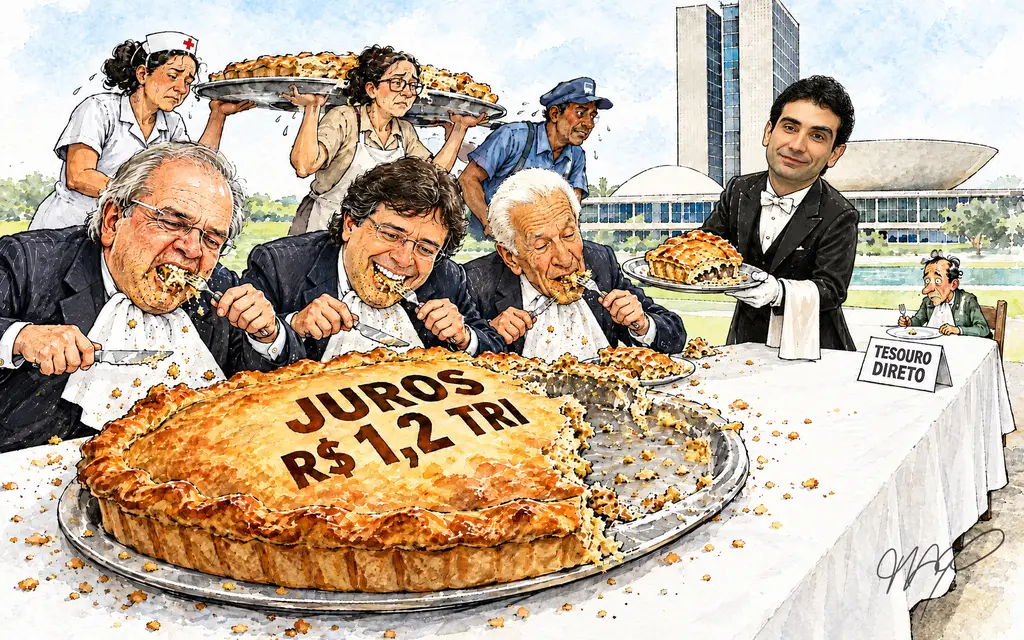
The public sector paid R$1.205 trillion in interest in the 12 months through September, 17 times the primary deficit and 7.6 times the Bolsa Família budget. More than half of federal debt bonds are held by banks and investment funds. The small Tesouro Direto saver holds 3.1%.
Adapted translation of the Portuguese original. Read the original.
 Cartoon
In the 12 months through September, Brazil's public sector paid R$1.205 trillion in interest on its debt, according to the Central Bank of Brazil. That is 8.99% of everything the country produced in the period, the highest percentage since January 2016. A year earlier, the bill had been R$984.8 billion. It rose R$220 billion in one year.
To put it in perspective: that works out to R$5,625 per Brazilian, babies included, going by the population estimated by IBGE, the national statistics agency. It is 7.6 times the 2026 budget of Bolsa Família, the cash-transfer program, of R$158.6 billion. And it is 17 times the primary deficit of the same period, R$70.1 billion. The primary deficit is the difference between what the government collects and what it spends on health, schools, pensions, public works and salaries, not counting interest. It is the one the editorials talk about every day.

Who receives it
Interest on public debt does not vanish. It is the income of those who hold government bonds. And the Treasury says every month who holds them. In September, according to the Monthly Debt Report, financial institutions held 31.3% of the domestic federal debt, and investment funds, 22.9%. Together, 54.3%: more than half. Pension funds held 22.4%, and foreign investors, 9.6%. The rest, 13.8%, sits with insurers, government and others.
At the other end is the saver who buys bonds online. Tesouro Direto, the Treasury's retail bond platform, has 3.9 million active investors and R$279.3 billion invested. Against the R$9.04 trillion of domestic marketable debt, that is 3.1%. When someone defends a high Selic (Brazil's benchmark interest rate) in the name of the “small investor,” it is these 3.1% they are talking about.
If interest were divided in proportion to bond holdings, the math is simple: banks and investment funds took about R$650 billion in one year. It is not exact, because each type of bond yields differently, but that is the order of magnitude. And more than half of the federal debt, 51.6%, pays the Selic itself. Every point the Copom, the Central Bank's rate-setting committee, holds on the rate turns, almost instantly, into income for those who hold these bonds.
Who pays
Who pays is the budget, that is, everyone. The fiscal framework caps primary spending, but not interest: there is no target for it, and no vote to pay it. The bill grows on its own, at every Copom meeting that keeps the Selic where it is.
That is what André Lara Resende's proposal to cut the Selic to 7.5% in a year is about, and it irritated the financial speculators on Monday. By his math, the change would save about 4% of GDP a year. Today the Copom meets again and decides the rate tomorrow, Wednesday (November 4). It stands at 13.75%. Every point lower is money that stops leaving the public budget as interest, and is left over for what the 214 million Brazilians use.
Sources
- Juros da dívida pública chegam a R$ 1,2 trilhão em 12 meses, aponta Banco Central
Nominal interest of R$1.205 trillion (8.99% of GDP) in the 12 months through September 2026, the highest percentage since January 2016, against R$984.8 billion (7.86%) a year earlier; primary deficit of R$70.1 billion (0.52% of GDP).
Regional report reproducing the Central Bank's Fiscal Statistics; numbers checked at Poder360.
- Dívida bruta fica em 82,9% do PIB, diz Banco Central
Nominal interest of the consolidated public sector totaled R$1.205 trillion in the 12 months through September, and R$107.5 billion in September alone.
- Dívida Pública sobe 0,97% em setembro e encosta em R$ 9,4 trilhões
In September, financial institutions held 31.33% of the domestic federal public debt; investment funds, 22.93%; pension funds, 22.41%; non-residents, 9.58%; other groups, 13.76%. Federal debt reached R$9.383 trillion, 51.6% linked to the Selic.
- Dívida pública federal atingiu R$ 9,3 trilhões em setembro de 2026
The domestic federal marketable public debt (DPMFi) went from R$8.944 trillion in August to R$9.037 trillion in September.
- Investimentos no Tesouro Direto somam R$ 8,77 bi em setembro
The Tesouro Direto stock reached R$279.3 billion in September, with 3,924,677 active investors.
- Orçamento de 2026 confirma R$ 158 bilhões para o Bolsa Família
The 2026 Budget Law set aside R$158.63 billion for Bolsa Família.
- Brasil chega a 214,2 milhões de habitantes em 2026, diz IBGE
IBGE estimated 214,211,951 inhabitants in Brazil on July 1, 2026.