Lara Resende Proposes a 7.5% Selic, and Financial Speculators Get Irritated
One of the fathers of the Real Plan wants to cut the benchmark rate from 13.75% to 7.5% in a year, because it is interest, not spending, that makes public debt grow. Over 12 months, the public sector paid R$1.205 trillion in interest, 17 times the primary deficit. The idea reached Lula's campaign platform, and the harshest reaction came precisely from those who live by speculating with capital.
Adapted translation of the Portuguese original. Read the original.
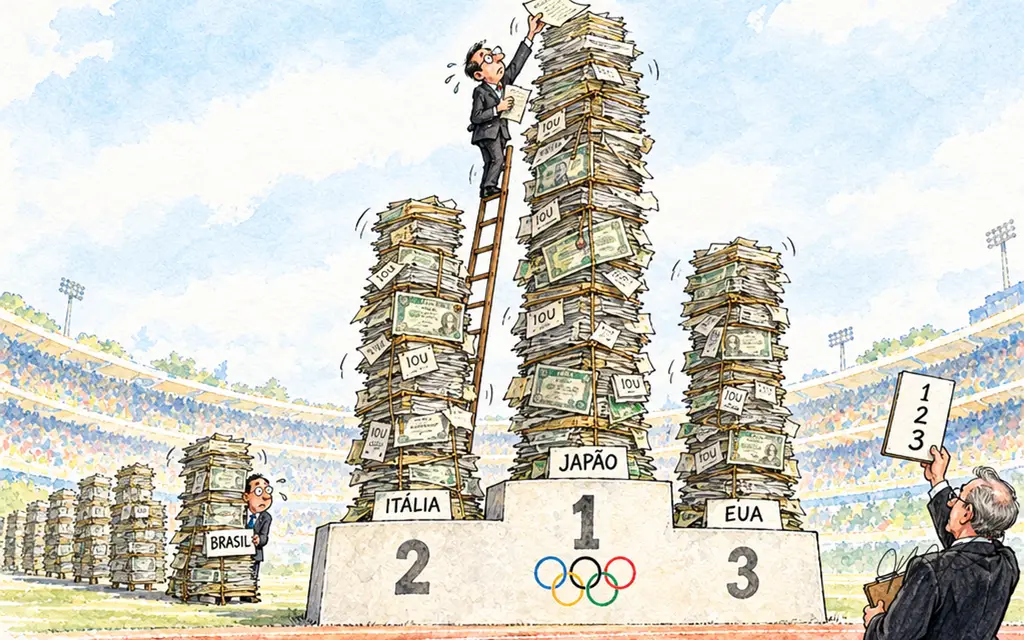
 Cartoon
André Lara Resende is not a left-wing economist. He helped design the Real Plan, headed the BNDES development bank under President Fernando Henrique Cardoso and spent part of his life in banks. On September 25, he published a Substack text that opens with an accusation: the Central Bank of Brazil sustains, “in the name of an anachronistic theory,” the interest rates that most unbalance the public accounts. And he made a round-number proposal: take the Selic (Brazil's benchmark interest rate) from 13.75% to close to 7.5% a year, in about 12 months.
The proposal spent a month circulating among economists. This Monday (November 2), it became a matter of government. José Sergio Gabrielli, coordinator of the Lula campaign's platform, wrote in a study on 2027 fiscal policy that it “deserves special attention”. That is when Faria Lima, São Paulo's financial district, woke up.
The Bill Nobody Puts in the Editorial
Lara Resende's argument is arithmetic. Brazil's gross debt grows about 12.7% a year, and nominal GDP about 7%. The gap does not come from hospitals or from Bolsa Família, the cash-transfer program. It comes from the interest rate that the Central Bank itself sets and that the Treasury pays on the debt.
The Central Bank published the numbers last week. In the 12 months through September, the public sector paid R$1.205 trillion in interest, 8.99% of GDP, the highest share since January 2016. Over the same period, the primary deficit, which is the difference between what the government collects and what it spends on everything except interest, was R$70.1 billion, 0.52% of GDP. Interest cost 17 times the primary deficit. Gross debt reached 82.9% of GDP.
Gabrielli summed it up in the same study: “The trajectory of the debt-to-GDP ratio is fundamentally driven by the behavior of interest rates”.
What the Proposal Says
The 7.5% did not come out of a hat. It adds the inflation target, 3%, to the growth the economy can sustain without accelerating prices, estimated at 2.5%, plus a safety margin of 2 points. Under the proposal, the drop would be gradual and announced in advance. A National Fiscal and Monetary Council, broader than the current National Monetary Council, would set targets for both sides for four or five years. If the dollar spiked during the transition, the Central Bank would use the international reserves to hold the exchange rate. Lara Resende estimates the change would save about 4% of GDP a year in interest.
The Irritation
The reaction came fast and from a familiar address. Felipe Miranda, founder of Empiricus, which sells investment recommendations, said he admires the author “as an intellectual” but thinks the proposal is “very bad.” Jason Vieira, chief economist at the bond broker Lev DTVM, was shorter: “Ridiculous, simply ridiculous.” Alexandre Schwartsman, a former Central Bank director, joked on X that he would accept the idea if Lara Resende took over the Finance Ministry and kept all his assets in Brazil, in reais. Ana Paula Vescovi, a former Treasury secretary and former chief economist at Santander, found it risky to use the reserves in a “bet.”
The common argument is that low interest by political decision scares investors, sinks the real and brings inflation back. It is a real risk, and the proposal itself admits the exchange rate may suffer at first. But it almost always arrives without the other half of the bill: the R$1.205 trillion a year has a recipient. Interest on public debt is income for those who hold public debt. For them, a 13.75% Selic is not a problem to be solved. It is the monthly paycheck.
Not every critic is from Faria Lima. José Luis Oreiro, a professor at the University of Brasília, agrees that interest is what weighs on the debt, but thinks the solution “suffers from naive voluntarism”: without changing the debt structure first, he predicts a currency crisis.
What the Government Says
For now, nothing changes. Finance Minister Dario Durigan said there is no interest-rate cap proposal on Lula's table and denied that a meeting with Lara Resende is scheduled. The Selic remains in the hands of Copom, which meets this Tuesday and Wednesday (November 3 and 4). The rate is now at 13.75%. On the Treasury's books, the debt keeps growing faster than the country.
Sources
- Conheça a proposta de André Lara Resende para limitar juros
Lara Resende proposes gradually reducing the Selic, over about 12 months, to close to 7.5% a year and creating a National Fiscal and Monetary Council; gross debt grows about 12.7% a year, and nominal GDP about 7%.
Summarizes a text published on the economist's Substack on September 25, 2026.
- Coordenador do programa de governo Lula endossa ideia de Lara Resende
The 7.5% adds the inflation target (3%), potential real growth (2.5%) and a 2-point margin; the proposal provides for using reserves to smooth the exchange rate and estimates savings of about 4% of GDP a year. José Sergio Gabrielli, coordinator of Lula's campaign platform, endorsed the idea.
- 'Muito ruim', 'ridícula' e 'voluntarismo ingênuo': economistas criticam proposta de Lara Resende para Selic a 7,5%
Felipe Miranda (Empiricus) called the proposal "very bad"; Jason Vieira (Lev DTVM), "ridiculous"; José Luis Oreiro (UnB) saw "naive voluntarism"; Alexandre Schwartsman joked on X; Ana Paula Vescovi criticized the use of reserves.
- Selic a 7,5% para conter a dívida? Proposta de Lara Resende ganha apoio no PT e provoca reação
Gleisi Hoffmann praised the article; Finance Minister Dario Durigan said there is no interest-rate cap proposal on Lula's table and denied a scheduled meeting with Lara Resende.
- Juros da dívida pública chegam a R$ 1,2 trilhão em 12 meses, aponta Banco Central
In the 12 months through September 2026, the consolidated public sector paid R$1.205 trillion in nominal interest (8.99% of GDP, the highest share since January 2016); the primary deficit was R$70.1 billion (0.52% of GDP); gross debt reached 82.9% of GDP.
Regional report reproducing the Central Bank's fiscal statistics; numbers checked in two other reports.
- Juros de R$ 1,2 trilhão, e não investimentos sociais, são o problema fiscal do Brasil, diz Gabrielli
In the study distributed on November 2, Gabrielli wrote that debt is driven by interest and that Lara Resende's proposal deserves special attention.