Agribusiness Exports to Europe Rise 14.8% in the First 5 Months of the Mercosur Deal
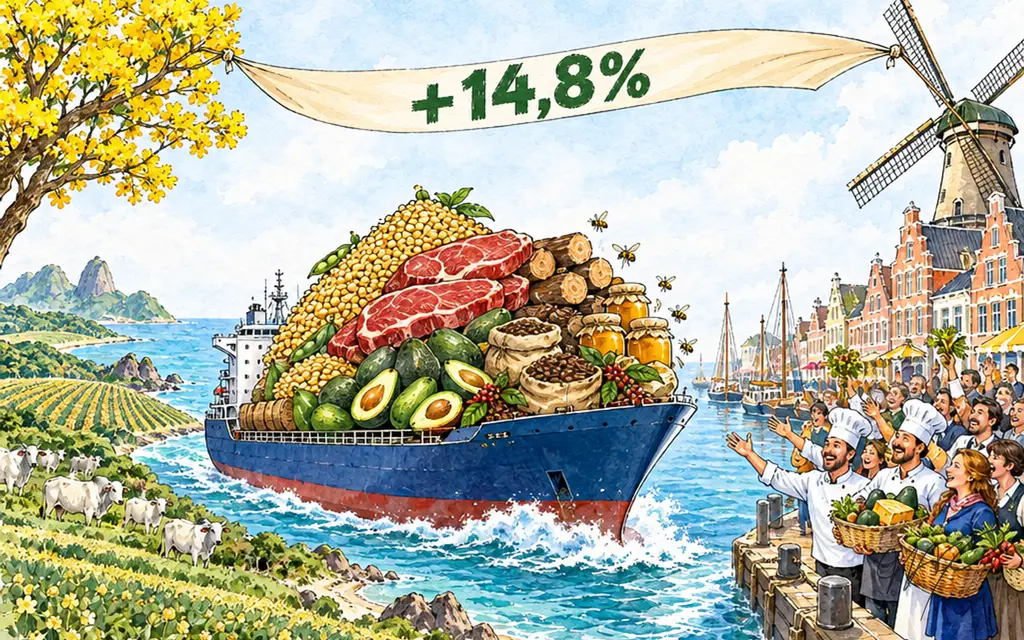
From May to September, Brazilian agribusiness sold US$12.2 billion to the European Union, US$1.57 billion more than in the same period of 2025. Meat doubled, soy rose 34%, avocado and honey multiplied. The surplus with the bloc grew 17%.
Adapted translation of the Portuguese original. Read the original.
 Illustration
What Has Changed Since May

The free trade agreement between Mercosur and the European Union took provisional effect on May 1, 2026, after 25 years of negotiation. Five months later, data from Agrostat, the foreign trade statistics system of the Ministry of Agriculture, show the first tally: between May and September, Brazilian agribusiness sold US$12.2 billion to the European bloc, against US$10.6 billion in the same period of 2025. That is 14.8%, or US$1.57 billion, more.
The growth was not just about price. In volume, shipments went from 16.42 million to 17.74 million tonnes, up 8.1%. And agribusiness's balance with Europe, already in Brazil's favor, grew 17%: from US$9.01 billion to US$10.54 billion, because purchases of European agricultural products rose much less, 3.3%.
What Drove It
Meat doubled: from US$604 million to US$1.23 billion, up 103.5%. The soy complex, the largest item on the list, rose 34.2%, to US$4.19 billion. Forest products, such as pulp and timber, grew 23%; the sugar and ethanol sector, 19.8%; fruits, nuts and chestnuts, 15%.
The biggest percentage jumps came from small products that gained access under the agreement. According to data from the Ministry of Development, Industry and Trade, which uses a different methodology, fresh avocado went from US$3.8 million to US$19.9 million (+421%), natural honey from US$2.3 million to US$10.8 million (+367%), corn oil from US$35.3 million to US$129.4 million (+266%) and ethanol nearly doubled, to US$131.8 million.
Not everything rose. Coffee, the second item on the list for Europe, fell 7.7%, to US$2.46 billion. Juices dropped 35.7%; tobacco, 15.9%; cereals and flours, 16.5%.
For the Year, and With Caution
Across all destinations, Brazilian agribusiness exported US$133.6 billion from January to September 2026, up 5.5% over the same period of 2025. Europe grew almost three times faster than the average.
Two cautions for anyone repeating the number. The first is the period: it is five months of the agreement, May to September, because the most recent Agrostat data is from September. The second is the cause: the sources caution that the rise cannot be attributed solely to lower tariffs, because international prices, harvests and exchange rates also changed over the period. What the data shows is that, in the agreement's first half-year in force, Brazil sold more, and at higher prices, to the market that took a quarter of a century to open.
The numbers
| Indicator | Value | Period | Area | Method |
|---|---|---|---|---|
| Agribusiness exports to the European Union | US$10.6 bn → 12.2 bn +14.8% in value | May to September (2025 × 2026) | Brazil → European Union | Agrostat/Mapa Source |
| Volume exported to the EU | 16.42 → 17.74 million tonnes (+8.1%) | May to September (2025 × 2026) | Brazil → European Union | Agrostat/Mapa Source |
| Agribusiness balance with the EU | US$9.01 bn → 10.54 bn +17% | May to September (2025 × 2026) | Brazil × European Union | Agribusiness exports minus imports, Agrostat/Mapa Source |
| Total agribusiness exports | US$133.6 bn +5.5% | January to September 2026 | Brazil → world | Agrostat/Mapa Source |
Sources
- Exportações do agro à UE crescem 15% nos cinco primeiros meses de acordo
May to September: US$10.6 bn (2025) → US$12.2 bn (2026), +14.8%, US$1.57 bn more. Soy complex 3.12 → 4.19 bn (+34.2%); meat 604.4 mn → 1.23 bn (+103.5%); forest products 1.20 → 1.48 bn (+23%); bee products +367.1%; sugar and ethanol sector +19.8%; fruit +15%. Declines: coffee -7.7%, juices -35.7%, cereals -16.5%, tobacco -15.9%. MDIC: avocado +421.2%, honey +367.1%, corn oil +266.3%, ethanol +95.2%, orange essential oil +75.8%, apple +28.8%.
The text cautions that the growth cannot be directly attributed to the agreement's concessions and that Mapa and MDIC use different methodologies.
- Exportações do agronegócio brasileiro à União Europeia crescem 14,8% após acordo comercial
Volume 16.42 → 17.74 million t (+8.1%); agribusiness balance with the EU 9.01 → 10.54 bn (+17%); imports of European agricultural products 1.62 → 1.67 bn (+3.3%).
- Brasil exporta US$ 133,6 bilhões em produtos do agro
January to September 2026: US$133.6 billion in agribusiness exports, up 5.5%.