
Democratic Spring: the far right begins to lose the world
From Budapest to Brasília, from Warsaw to Washington, those who swore they were the voice of the majority are being sent back to the opposition. By ballot.
The original was updated after this translation; the Portuguese version is the reference until we revise it. Read the original.
 Cartoon
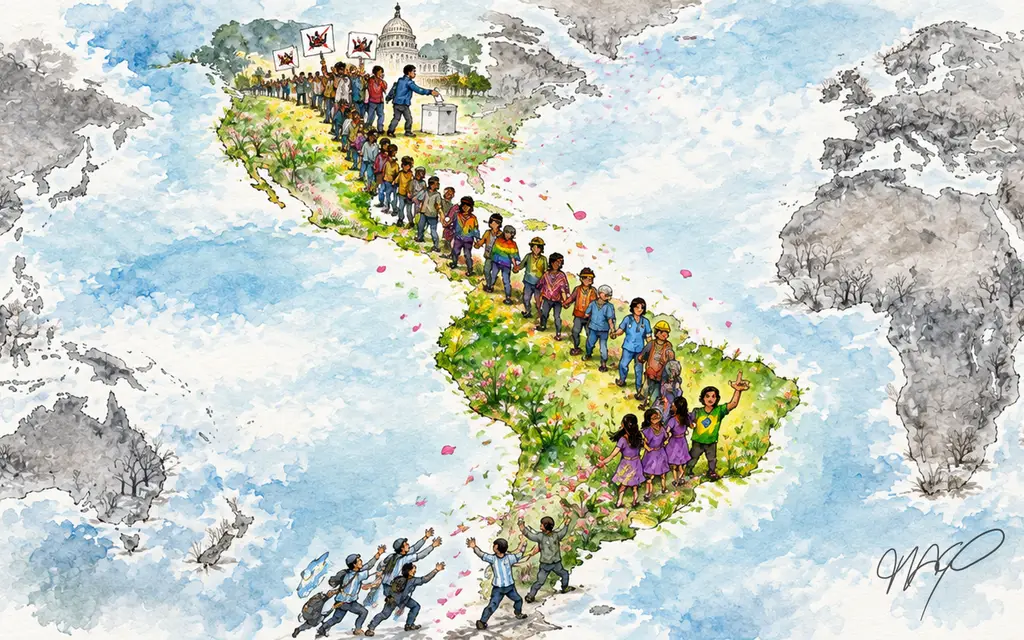
For a decade, the far right repeated the same sentence in several languages: we are the people. Orbán said it in Budapest, Trump in Washington, Bolsonaro in Brasília. Anyone who disagreed was an elite, a noisy minority, an enemy of the nation. The line worked for a long time. Now the people are answering, and the answer comes at the ballot box.
Budapest opened the season
In April, Hungary did what seemed impossible. Viktor Orbán, the man who invented “illiberal democracy” and became a model for the far right around the world, lost power after sixteen years. He did not lose to a coup or a revolution. He lost an election he had himself designed not to lose, with friendly media, the electoral map in his favor and the machinery of the state in his hands. Even so, Hungarians left their homes and sent him to the opposition.
Poland had already given the warning in 2023, when it removed from government the party that was trying to tame the judges and the press. Hungary confirmed that the warning was no exception.
The L for Lula
In Brazil, the story has two chapters. In 2022, Brazilians removed Bolsonaro from the Planalto (the presidential palace). In October 2026, they said no to his son. Lula was re-elected in a tough race, decided vote by vote, against a family that believed it had a hereditary right to power.
The victory did not fall from the sky. It started in the streets in 2018, with Ele Não (“Not Him”), when women were the first to say out loud what was at stake. Eight years later, it was they, the poorest Brazilians and the Northeast who held up the L.
The blue tsunami
Nine days later, it was the turn of the United States. Democrats took the House and the Senate and took away from Trump the Congress he used as a rubber stamp. Even Texas elected a Democratic senator. Young people and Latinos, whom Trump treated as a threat, returned the treatment at the ballot box.
There too, the streets came first. No Kings filled American cities with a simple idea: this country has no king. In November, the idea became a vote.
Why it is a spring
Spring is not revolution. Nobody was toppled, nobody stormed a palace. It is the opposite of what the far right did when it lost: there was no invasion of the Capitol and no encampment at the gates of a barracks. There was a line at the polling place.
What unites Budapest, Brasília and Washington is the same discovery. The minorities the far right picked as enemies, added together, are the majority. Women, young people, Black people, immigrants, the poor, the LGBT community, civil servants, teachers, people who just wanted to live in peace. Each group alone loses. Together, they win elections.
And no group was persecuted as much as trans people. They became the far right's favorite enemy the world over: Orbán banned the Pride march in Budapest, Trump signed an order to erase their existence from official documents and push them out of the armed forces, and here Bolsonarism made “gender ideology” its campaign scarecrow. They used the most vulnerable minority as a target because they thought nobody would defend it. They were wrong. Budapest filled the Pride march that had been banned, and the spring now blooming belongs to them too. A democracy is measured by how it treats those with the least power, and trans people were on the front line.
The next seasons
Spain votes on November 29, and Pedro Sánchez is already using the Brazilian example in his campaign. The right starts ahead, with the shadow of Vox. It is the next test.
And there is Buenos Aires. Javier Milei bet everything on Trump: photographs, hugs, promises of money. In nine days, he watched his Brazilian ally lose and his American patron shrink at home. Milei seeks re-election in 2027, and the wind that blew through Budapest, Brasília and Washington does not usually stop at the border.
Nobody should confuse spring with permanent victory. The far right lost elections, not voters, and it will be back. But the time when it could speak in the name of the people without being contradicted is over. The people have spoken. In Hungarian, in Portuguese, in English, and soon, who knows, in Spanish.