
American Spring: Lula's L and the blue tsunami
Brazil reelected Lula. In the United States, the Democrats won the House and the Senate. In nine days, two majorities handed defeats to Bolsonarism and Trumpism. Mexico has already shown the strength of a left-wing majority. Spain votes in November, and Milei heads into 2027 with his main ally weakened.
Adapted translation of the Portuguese original. Read the original.
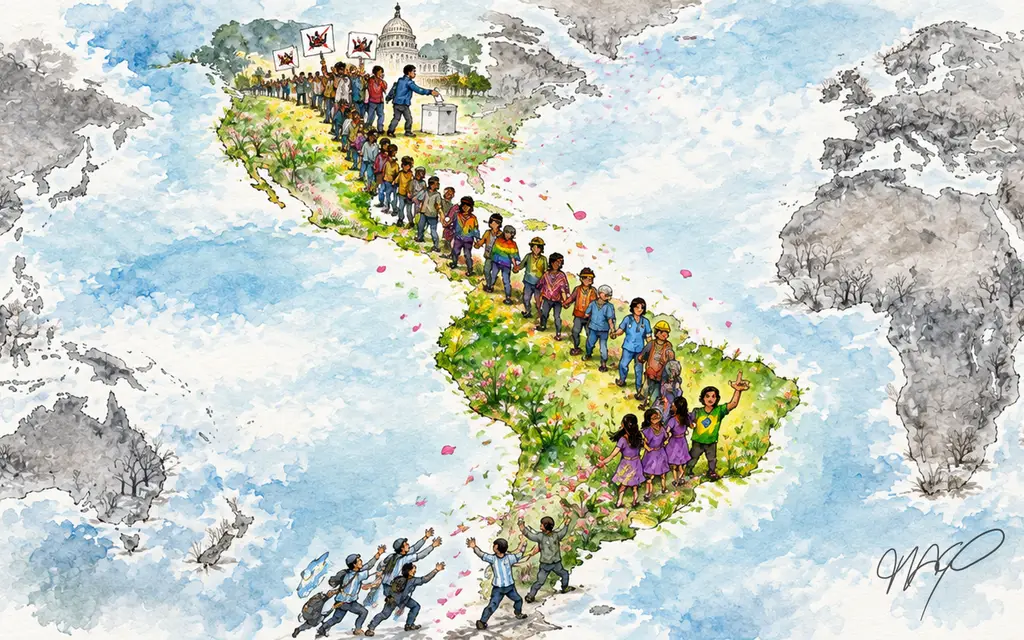 Cartoon
Together, We Are America
On February 8, at the Super Bowl halftime show, Puerto Rican star Bad Bunny sang in Spanish on the most American stage in American television. Near the end he said “God bless America” and began naming, one by one, countries of the Americas, including the United States and Canada. The ball he held read “Together, We Are America,” as the Associated Press reported.
That is the sense in which this spring is American. Brazilians, Mexicans, Argentines, Puerto Ricans and U.S. citizens are all Americans. Every country in the Americas is part of this story, with its own language, its own feuds and its own way of voting. In February, Bad Bunny put that idea on stage. Months later, two elections gave Abestadão reason to talk about spring.
First, Lula's L. Nine days later, the blue tsunami. In Brazil, Flávio Bolsonaro lost the race for the Planalto (the presidential palace). In the United States, Donald Trump lost the Republican majority in both chambers of Congress. These two victories at the ballot box are what Abestadão calls the American Spring. In each country, groups with different interests found enough votes to beat the right that claimed to own the majority.
Lula's L
On October 25, 2026, Lula beat Flávio Bolsonaro in the runoff with 64.2 million votes, 51.79% of valid votes. It was a narrow win. In the final stretch, the Datafolha poll of October 22 showed the two tied at 50% of valid votes. But the polls had already hinted at where the candidacy drew its strength: since August, Datafolha had shown Lula ahead among women, lower-income voters and Catholics.
The blue tsunami
On November 3, the Democrats' blue swept over the U.S. Congress. The party won the House and the Senate and took the Republican majority away from Trump in both. In Texas, James Talarico won the Senate race in a state that had not elected a Democrat in a statewide contest in 32 years.
The SSRS poll for the Associated Press and other outlets, published by NPR, helps explain the House vote. Young voters and Latinos drifted away from the Republicans, and only about a third of Latino voters said they voted for the Republican candidate in their district. The Democrats also flipped districts in states such as Kentucky, Missouri and Utah. The turnaround combined shifts in the makeup of the vote with gains in places where the party had been losing ground.
#EleNão (“Not Him”) in Brazil in 2018, and No Kings in the United States, had already shown in the streets the capacity to mobilize against Bolsonaro and Trump. In 2026, the new fact appeared at the ballot box, with Lula's reelection and the Democratic turnaround in Congress.
Mexico got there first
Mexico had already given its own answer in 2024. Claudia Sheinbaum, the candidate of the coalition led by Morena, was elected with 59.76% of the vote, keeping the left in the presidency. In October 2026, a national poll by El Financiero recorded 69% approval for her government. The Mexican parallel is that of a majority that has already reached power and remains strong in the polls. The next test at the ballot box comes on June 6, 2027, when the country renews its entire Chamber of Deputies.
The blue tsunami also echoed across the border. Sheinbaum highlighted the wins of two politicians of Mexican origin in the races for governor of California and Texas, Xavier Becerra and Gina Hinojosa.
The L crosses the Atlantic
“If Brazil could do it, Spain can too,” said Pedro Sánchez, according to CNN Brasil, pointing to Lula's reelection as inspiration for the Spanish campaign. Spain returns to the polls on November 29 to elect the Congress of Deputies and the Senate. The L has already entered the conversation. The race, however, starts with an edge for the right: in the RTVE average updated on November 2, the PP was ahead of the PSOE and would have an absolute majority if it struck a deal with Vox. That is where the reach of the Brazilian example gets measured.
Milei's embarrassment
In Buenos Aires, the blue tsunami exposed the size of Javier Milei's bet on Donald Trump. The Argentine president made Trumpism his great foreign reference point. In nine days, he watched Flávio Bolsonaro lose in Brazil and his main ally lose control of the U.S. Congress. La Nación reported pessimism at the Casa Rosada and worry about whether Washington's backing will continue, even though the government says it trusts that it will. Hence the embarrassment: Milei tied his government's international prestige to Trump and now hopes that his ally, weakened at home, still has the strength to help him.
Milei has already announced that he will run for reelection in 2027. Until then, Lula's L and the blue tsunami leave a message for those who got used to speaking in the name of the majority: a majority is counted at the ballot box.
At the Super Bowl, Bad Bunny raised a ball to say who belongs in America. In Brazil and the United States, millions of voters said at the ballot box who can form a majority.
The American Spring is something else: it overthrows no one, it votes.
Sources
- Bad Bunny's Super Bowl halftime show celebrated America – all of it – with a message of unity
At the Super Bowl halftime show, Bad Bunny said God Bless America, named countries of the Americas, including the U.S. and Canada, and held a ball reading Together, We Are America.
The full order of the countries named was not checked.
- Lula é reeleito presidente com vantagem no Nordeste; Flávio liderou no Sul e Centro-Oeste
Lula was reelected with 64.2 million votes, 51.79% of valid votes.
- Datafolha: Flávio e Lula empatam em 50% de votos válidos no 2º turno
In the final stretch, the Datafolha poll of 10/22 showed Lula and Flávio tied at 50% of valid votes.
Voting-intention poll.
- Datafolha: Lula lidera entre mulheres e pobres; Flávio, entre evangélicos
In August, Datafolha showed Lula ahead among women, poorer voters and Catholics.
August poll, conducted August 18 to 19 with 2,058 voters.
- Democrat James Talarico wins U.S. Senate seat, ending GOP's 32-year Texas statewide winning streak
James Talarico won the Senate race in Texas, ending 32 years without a Democratic win in a statewide election.
- Young voters led a sharp shift toward Democrats in the 2026 midterms, The AP Voter Poll finds
Young voters and Latinos drifted away from the Republicans; only about a third of Latinos voted for the Republican in their district.
Preliminary data.
- See how Latinos, young voters and other demographic groups fueled Democrats' big wins
The voter poll is by SSRS for the Associated Press and other outlets.
- All the House districts that flipped in the 2026 midterm elections
The Democrats flipped House districts in states such as Kentucky, Missouri and Utah.
- Claudia Sheinbaum mantiene ventaja con 59.76% en Cómputos Distritales; van al 99.79%
Sheinbaum was elected in 2024 with 59.76% of the vote.
District count at 99.79% of the tally sheets.
- Aprobación a Claudia Sheinbaum es de 69% en octubre: Encuesta EF
In October 2026, the Sheinbaum government had 69% approval.
- Elecciones 2027: el calendario que debes conocer para seguir todo el proceso hasta los resultados oficiales
On June 6, 2027, Mexico renews its entire Chamber of Deputies.
- Destaca triunfo de políticos de origen mexicano en intermedias de EU
Sheinbaum highlighted the wins of Xavier Becerra in California and Gina Hinojosa in Texas.
- Reeleição de Lula mobiliza esquerda internacional; entenda
Pedro Sánchez pointed to Lula's reelection as inspiration for the Spanish campaign.
- Real Decreto 806/2026, de 5 de octubre, de disolución del Congreso de los Diputados y del Senado y de convocatoria de elecciones
Spain elects the Congress of Deputies and the Senate on November 29.
- Encuestas elecciones generales: PP y Vox podrían gobernar
In the RTVE average updated on 11/2, the PP was ahead of the PSOE and would have an absolute majority with Vox.
Without Vox, the PP does not reach a majority.
- El Gobierno reconoce que la derrota de Trump fue 'peor de lo esperado', pero confía en que continúe el apoyo de EE.UU. a la Argentina
La Nación reported pessimism at the Casa Rosada and worry about the continuity of Washington's backing.
The Argentine government says it trusts the support will continue.
- Javier Milei confirmó que va por la reelección en 2027 y ya definió su compañero de fórmula
Milei will run for reelection in 2027.
- Atos contra Bolsonaro são realizados nos 26 Estados e no DF; assista a vídeos
#EleNão brought the mobilization against Bolsonaro to the streets in 2018.
- Millions join No Kings protests in one of largest US rallies
No Kings brought the mobilization against Trump to the streets.
Crowd estimates from the organizers.