Betting firms and clubs held 17 of the 26 seats at Fux's hearing, and the bettor was left outside
On Tuesday, November 3, the Supreme Federal Court hears from those who want to overturn the betting ban. Justice Luiz Fux's first list had ten clubs, the CBF, the betting houses' associations and the TV broadcasters' association. Psychiatrists, consumer advocates and child-protection groups, heard in 2024, were not invited. Outside the court, the Bets Nunca Mais petition already tops 140,000 names.
Adapted translation of the Portuguese original. Read the original.
 Cartoon
At 10 a.m. this Tuesday, November 3, the Supreme Federal Court (STF), Brazil's top court, opens the Second Panel's chamber to hear what Brazil thinks of the betting ban. Brazil, in this case, arrives in cleats. First speaker in line is Flamengo.
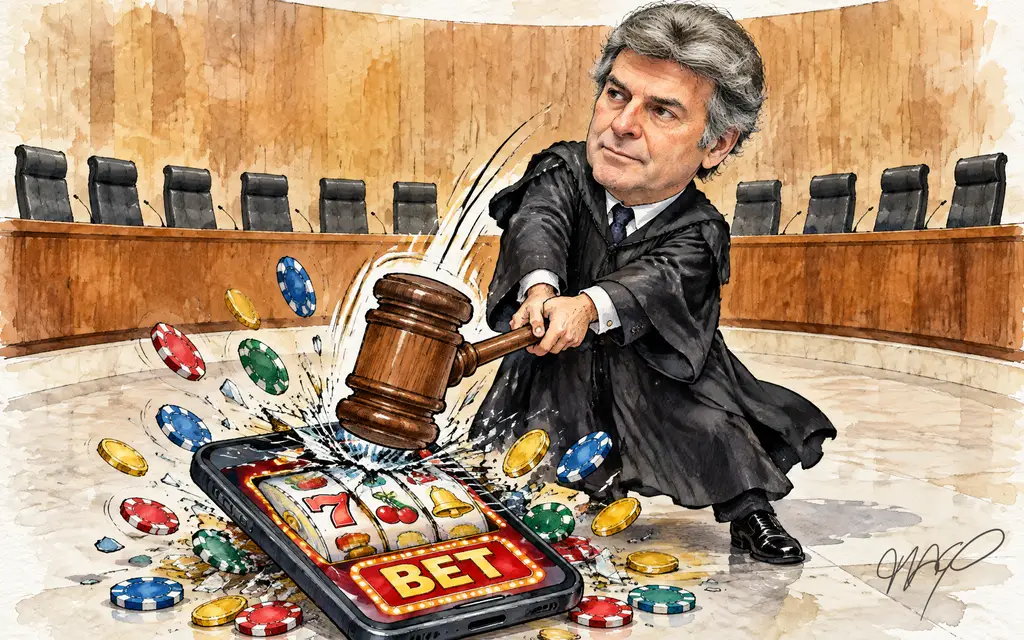
The public hearing was called by Justice Luiz Fux, rapporteur of the case in which the National Association of Games and Lotteries (ANJL) asks to strike down Provisional Measure 1,394, issued on September 25. The measure took fixed-odds betting houses, sites and apps offline, and banned advertising. Fux did not suspend the measure. He preferred, first, to hear the interested parties.
The October 26 list
In the October 26 order, the interested parties numbered 26. Ten soccer clubs: Flamengo, Fluminense, Botafogo, Cruzeiro, São Paulo, Corinthians, Ponte Preta, Vitória, Guarani and Portuguesa. The CBF, the national soccer confederation. The betting houses' own organizations, the ANJL and the Brazilian Institute of Responsible Gaming (IBJR), plus other industry associations. The National Confederation of Commerce, the one for Industry, the Brazilian Association for Economic Freedom. And Abert, which brings together the radio and television broadcasters, the ones that air the matches with a betting-house sign on the pitch, on the jersey and at halftime.
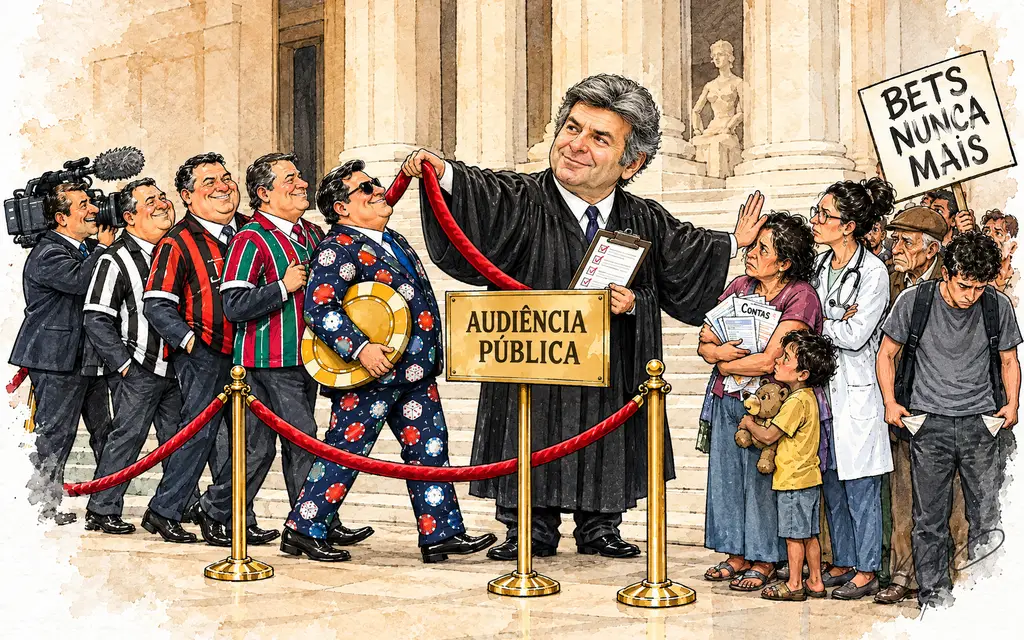
By the count of the Attorney General's Office (AGU), 17 of the 26 guests were soccer clubs or betting representatives. On the other side of the table, the government, which issued the measure, and the Prosecutor General's Office (PGR).
The reason for so many clubs has a name in the accounting books. Betting sponsorships accounted for 7.9% of Série A clubs' revenue in 2025. According to Folha, cited by BNLData, the hearing would serve to discuss a deal among the government, betting companies and clubs. The solution making the rounds would keep sports betting, the kind that matters to soccer, and ban online casinos.
Who was not on the list
At the previous hearing on the same subject, in November 2024, the STF heard the Brazilian Psychiatric Association, the Alana Institute, which works for children, and Idec, a consumer defense group. None of the three was called this time. There was also nobody from the Health Ministry on the first list.
On October 30, eight consumer defense organizations signed a statement asking to speak, even if by video, and, failing that, a hearing just for those who lose money on bets. To remind the rapporteur why the consumer matters, they quoted the rapporteur himself. In a ruling on betting, Fux wrote that people spend on bets the money meant for consumption and for their subsistence minimum. To secure a seat in 2026, the sentence was not enough.
The AGU complains, the list grows
The AGU asked the justice to broaden the adversarial debate, because the lineup was predominantly sports organizations and betting operators. On Sunday, November 1, Fux granted part of the request. In came the Health and Justice ministries, the Brazilian Supermarket Association, the Paralympic Committee, the National Federation of Professional Soccer Athletes and one more club, Grêmio. The list reached 34.
The supermarkets got in because the money that goes to betting stops going to the shopping cart. The consumer organizations, which have been saying exactly that for years, stayed out. As of press time, their requests had no public answer. Abert remains on the list. Each guest will have ten minutes.
Outside
While the list was being drawn up, a campaign began collecting signatures at the courthouse door, online. The Bets Nunca Mais petition, from the Instituto Conhecimento Liberta, asks for three things: that the ban remain in force, that betting sponsorship of clubs, broadcasts and influencers end, and that there be public care for those who became addicted and for indebted families. On Monday night, November 2, the site's counter stood at 140,012 signatures.
That is 140,000 people without ten minutes at the microphone. Enough to fill the Maracanã almost twice. Flamengo, which speaks at 10:10 a.m., knows a full house well.
The hearing decides nothing: it serves for the rapporteur to gather arguments before voting. The measure remains in force, and Congress has until the end of the constitutional deadline to vote on it. The argument of someone who lost the month's paycheck on an app will reach the Supreme Court the way it has so far: in writing, from outside, with a name and taxpayer ID number (CPF).
Sources
- STF realizará audiência pública sobre MP das bets
Fux called a public hearing with 26 institutions, among them ANJL, IBJR, CNC, CNI, the Finance Ministry, AGU, ten soccer clubs, CBF, PGR, Abert, Abracrim and UERJ Reg.
The full list is in the attached order.
- STF divulga cronograma de audiência pública sobre proibição das bets
The initial schedule had 28 organizations, with ten minutes for each.
- STF realiza nesta terça (3) audiência pública sobre proibição das bets
The hearing is this Tuesday (3), at 10 a.m., in the Second Panel's chamber, broadcast on TV Justiça and the STF's YouTube channel.
- Luiz Fux acata pedido da AGU e inclui opositores das bets na audiência pública do STF
The AGU pointed out that the list was made up predominantly of sports organizations and betting operators; before the request, clubs and representatives of the betting houses were 17 of the 26 summoned. Fux added the Health and Justice ministries, Abras, the Paralympic Committee, Fenapaf and Grêmio, and the list reached 34.
Trade publication covering the betting sector.
- STF debate proibição das bets nesta terça; audiência terá 34 entidades após pressão do governo
Organizations in psychiatry, addiction prevention, consumer defense and child protection heard in 2024 were not invited. The government estimated a loss of R$1.541 billion in tax revenue in 2026 from the ban.
- STF ouve 34 entidades sobre a MP das bets na terça; Fux inclui governo e Abras
The Brazilian Psychiatric Association, the Alana Institute and Idec, heard at the 2024 hearings, were not called for the November 3 one. Flamengo opens the line of speakers at 10:10 a.m.
- Audiência pública das bets no STF: entidades de defesa do consumidor pedem para participar
Eight consumer defense organizations, among them Idec, Brasilcon, the National Forum of Civil Entities and Procons Brasil, asked to speak and, if that was not possible, for another hearing just for consumers. They cited a sentence by Fux himself in a ruling on betting.
- Fux atende pedido da AGU, convoca audiência sobre a MP das bets e acena com acordo que pode resolver a crise
According to Folha, cited by BNLData, the hearing was called to discuss a deal among the government, betting companies and clubs; the order did not grant the injunction and the provisional measure remains in force. Betting sponsorships were 7.9% of Série A clubs' revenue in 2025.
Trade publication covering the gaming sector.
- Medida provisória proíbe o funcionamento de bets no Brasil
Provisional Measure 1,394, of September 25, 2026, bans the operation, offering and advertising of fixed-odds betting in the country.
- Abaixo-assinado contra a volta das bets
The petition asks that the ban remain, that betting sponsorship of clubs, broadcasts and influencers end, and that there be public care for those who became addicted and for indebted families. The counter showed 140,012 signatures on 11/2/2026.
The site's own count.